Every Team Its Own Language
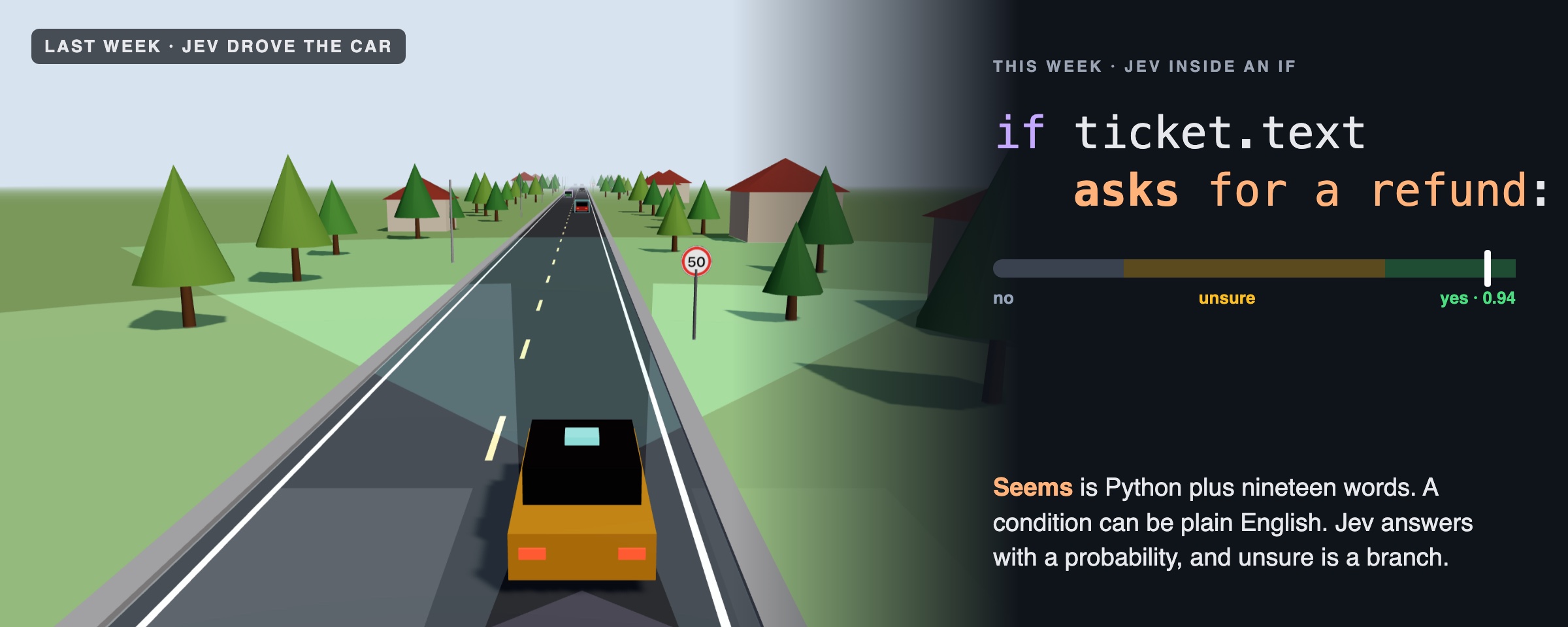 Last week Jev drove a car in a simulation. This week it sits inside an if statement.
TL;DR: TypeSafe released Jev, a System One model: it does not write text, it answers typed questions with a probability. I spent a week playing with it, a support inbox, then a driving simulation. Then I asked what a language would look like with Jev inside it. One hour with Claude Code on Fable: Seems, Python plus nineteen words. Every Python library keeps working. When a language costs an hour, every team will have its own. This is a Cambrian explosion in the software industry. The code, a playground and the language guide are public.
From the road to an if
Jev returns a typed answer with a probability, in under a second, for a fraction of a cent. That is a different tool from an LLM, so I played with it: a support inbox with six judgments per message, then a driving simulation where Jev picks the manoeuvre and code drives the car. Each experiment ended with the same question: where else does this fit?
The candidate at work is our customer support agent. It handles about 90% of our customer conversations on its own, it is mostly Python, and some of its decisions are a poor fit for a generative model: fast routing, yes/no checks, a position on a scale, a clear “not sure” instead of a paragraph. The vendor’s SDK would do. Then the question that only makes sense in this era: why call a library, when the thing I want is a control statement? Two criteria: everything we already use keeps working, drop-in, and a new judgment statement I can add where I need it and nowhere else. An hour later I had Seems. The rest of the day went into the playground, the tests and the guide.
Python plus nineteen words
amount > 500 is exact, and Python answers it. text asks for a refund is a judgment, and Jev answers it. The grammar decides which is which, not the model.
if amount > 500 and text asks for a refund:
    send_to_manager(ticket)
else:
    close(ticket)
unsure:
    ask_a_person(ticket)
- The English after the verb goes to Jev as the question “Does this ask for a refund?”. No prompt. No model reads the program.
- At or above 0.75 is yes, at or below 0.25 is no, between is unsure.
unsure:is a branch. Without it, an unsure judgment raises an exception, so a program cannot act on a guess by accident. - Seems is a superset of Python. Every Python program is a valid Seems program, and every library keeps working.
- Judgments travel together. Eight support tickets: 32 judgments, 8 requests, one second, $0.0002.
- The exit is one command.
seems translateemits plain Python.
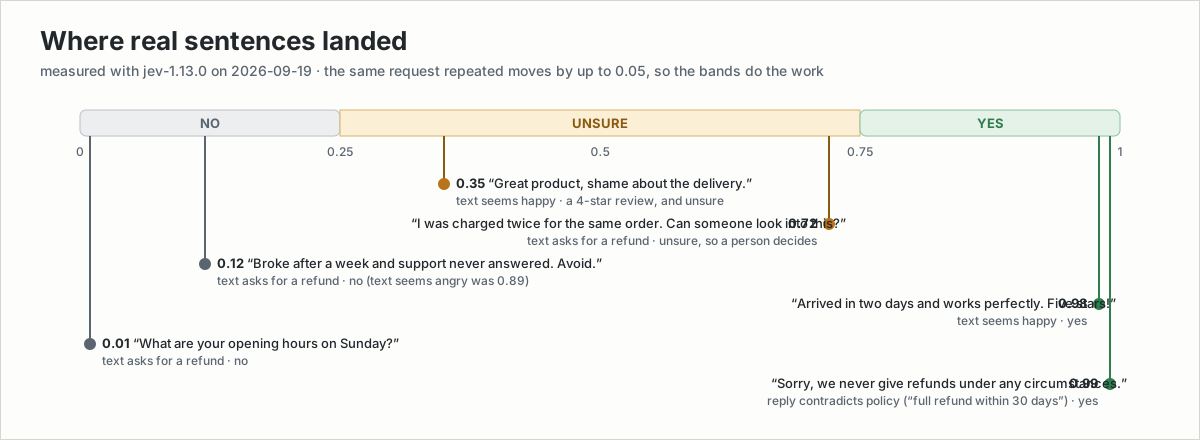 Where real sentences landed on the yes, unsure, no scale
The two in the middle are the point. “I was charged twice. Can someone look into this?” is a refund request to a human reader and 0.72 to Jev. On a 0.75 bar that is unsure, so the program hands it to a person instead of paying out. No threshold is written anywhere in the program.
What I saw
- Answers move. The same request sent three times moved by up to 0.05. A judgment on the 0.75 line can flip between yes and unsure. The cache makes a stored answer final, and a flip lands in “ask a person”, not in the opposite action.
- A loose phrase gets a loose answer. Jev reads literally. When it matters, a
judgmentblock with yes and no criteria is the right tool. - Jev is not for math. Counting, arithmetic, dates and lookups stay in Python.
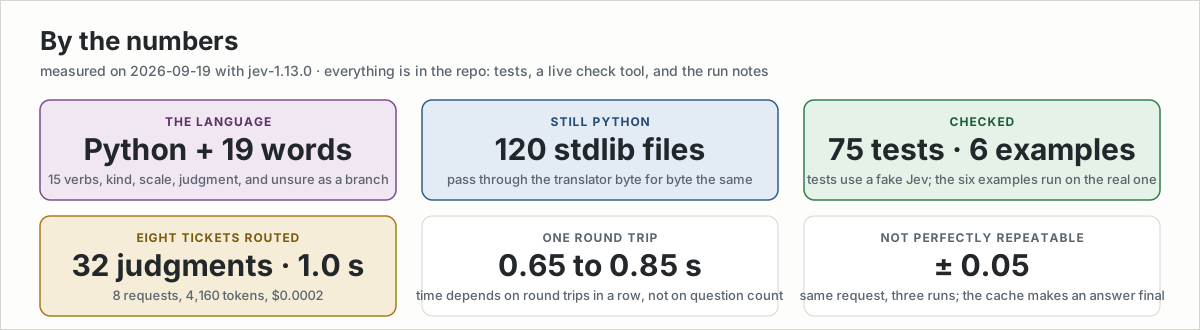 Seems, by the numbers
Every team its own language
I do not know yet whether our support agent gets Seems or the SDK. That decision is small. What the week left behind is not.
We have lived with a handful of languages for decades, and the reason was never that writing a parser is hard. A parser is a weekend. The cost was the lifetime: every reader has to learn the language, every editor and debugger has to understand it, every hire has to be found, every security review has to read it. People paid those costs, for years, so teams styled themselves to the language instead of the other way round.
Every one of those costs has just moved. The writer of the language is an AI. The maintainer of its tooling is an AI. The reader is, increasingly, an AI as well: the same model that wrote Seems in an hour reads any Seems program without a manual. When the lifetime of a language is carried by machines on both sides, the old reason to stop at a few languages is gone.
What comes is not a thousand languages from scratch. It is dialects on top of the languages we have: Python plus nineteen words for a support team, Go plus whatever a payments team needs. That is what made an hour enough. Biology had its Cambrian explosion when a new body plan became cheap to try and had room to survive: a new genetic toolkit, and empty niches. Most plans died. The survivors were selected, not designed. Software is entering the same period, in a softer form. The discipline that survives with the dialects is old: a strict grammar, plain output anyone can read, tests, and a model that is only allowed to answer typed questions.
Code, tests and run notes: github.com/kavehmz/seems-lang. The language guide: kavehmz.github.io/seems-lang.
Previously: Cognitive Programming Language · The Spec Factory · Write for the AI That Doesn’t Exist Yet
Posted on September 19, 2026